

In warehouse storage design, flue spaces are one of the most overlooked elements of fire protection. Yet, maintaining clear flue spaces can significantly affect how a fire behaves and how quickly it can be contained. For warehouse operators and safety professionals, understanding and managing flue spaces is a key part of maintaining a fire-safe environment.
What Are Flue Spaces?
Flue spaces are the vertical and horizontal gaps between rows of palletized goods in racking systems. These spaces provide pathways for heat and smoke to rise and for fire suppression systems, particularly sprinkler systems, to effectively reach the base of a fire. There are two primary types:
Transverse Flue Spaces: The space between back-to-back racks, typically 6 inches.
Longitudinal Flue Spaces: The space between loads and the upright frame, typically 3 inches from each side of racking and 6 inches between loads.
When these spaces are blocked, it becomes much harder for sprinklers to do their job, and the spread of fire can become far more severe.
Why Are Flue Spaces Important?
In the event of a fire, flue spaces function like vertical chimneys, allowing heat and smoke to rise. This upward airflow helps activate ceiling-level sprinklers faster and ensures that water reaches deeper into the racking system. Without these spaces, fire suppression is delayed, and the risk of extensive damage or injury increases.
Blocked flue spaces can also hinder firefighter access and visibility, compounding the hazard. Even the most well-designed sprinkler systems rely on unobstructed flue space to perform as intended.
What Do Fire Codes Say?
The National Fire Protection Association (NFPA) outlines specific requirements for flue spaces in NFPA 13, which is the Standard for the Installation of Sprinkler Systems. According to the standard:
Transverse flue spaces should be a minimum of 6 inches wide.
Longitudinal flue spaces (along the load face) should be at least 3 inches.
These guidelines are enforced by local fire marshals and building inspectors, and compliance is often required as part of facility inspections. Failure to maintain clear flue spaces can lead to citations, required corrective actions, or increased liability in the event of an incident.
OSHA and General Safety Compliance
While OSHA doesn’t specifically regulate flue spaces in its standards, the agency can cite facilities under the General Duty Clause (Section 5(a)(1), if storage practices are deemed hazardous. This includes scenarios where poor racking arrangements or blocked flue spaces contribute to elevated fire risk.
Warehouse safety is a system, and fire prevention is a shared responsibility between storage design, employee behavior, and code-compliant equipment.
Maintaining Flue Spaces in Real-World Warehouses
In theory, it’s easy to maintain proper spacing between pallets and rack uprights. In reality, the fast pace of warehouse operations, personnel changes, and variations in load size can all contribute to inconsistent pallet placement. Relying solely on training and signage often leads to uneven results.
4 Ways to Improve Fire Code Compliance
Many warehouses can improve consistency by incorporating physical spacing tools that passively enforce compliance and reduce reliance on manual precision. These include:
Center Flue Spacers: Installed between back-to-back racks, these maintain the required 6″ transverse flue space by physically separating rack systems. They help ensure compliance with fire code even when pallets are loaded tightly.
Flue Spacers: Positioned along the uprights, these reinforce longitudinal flue space (typically 3″) by guiding pallet placement. They help prevent storage from encroaching into required vertical gaps, especially in high-turnover environments.
Beam Pallet Stops: Installed on rack beams, these stops prevent pallets from being pushed too deep into the racking, protecting the flue space between racking and against the wall. They offer a repeatable stopping point to promote consistent loading practices.
Floor Pallet Stops: Anchored directly to the floor, these stops help preserve flue space and prevent damage to perimeter walls. They’re ideal for use in back-to-back rack situations and along walls where spacing and protection are both needed.
Conclusion: Small Gaps, Big Impact
Flue spaces might seem like minor details in a complex warehouse environment, but they play a crucial role in protecting people, inventory, and infrastructure from fire-related damage. Whether you manage a single facility or oversee safety across multiple sites, taking the time to understand and enforce proper flue spacing is a critical step in maintaining compliance and reducing risk.
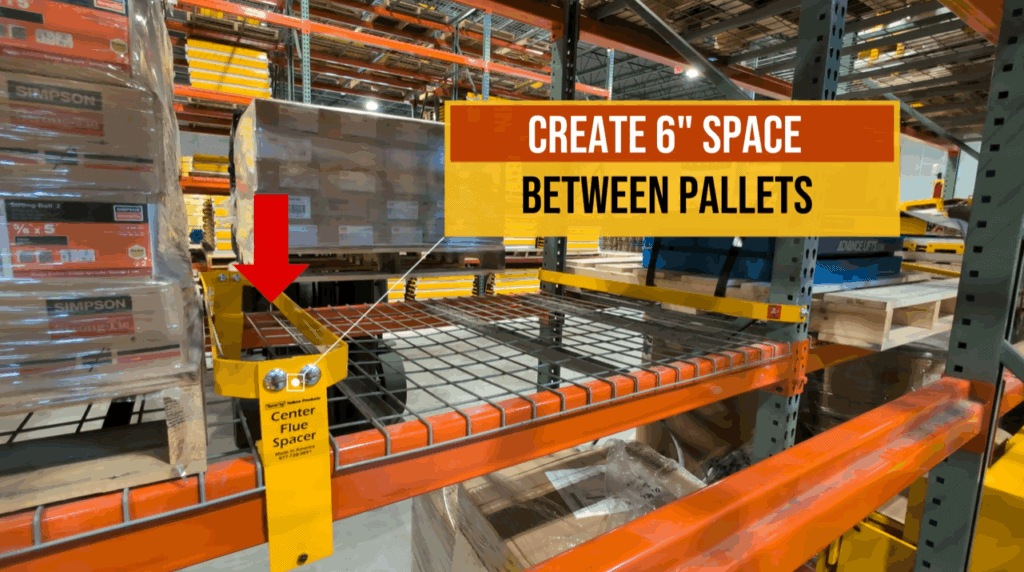
Click to watch our flue spacer protection products in action!